Rural Districts Lead SA Minimum Wage Non-Compliance
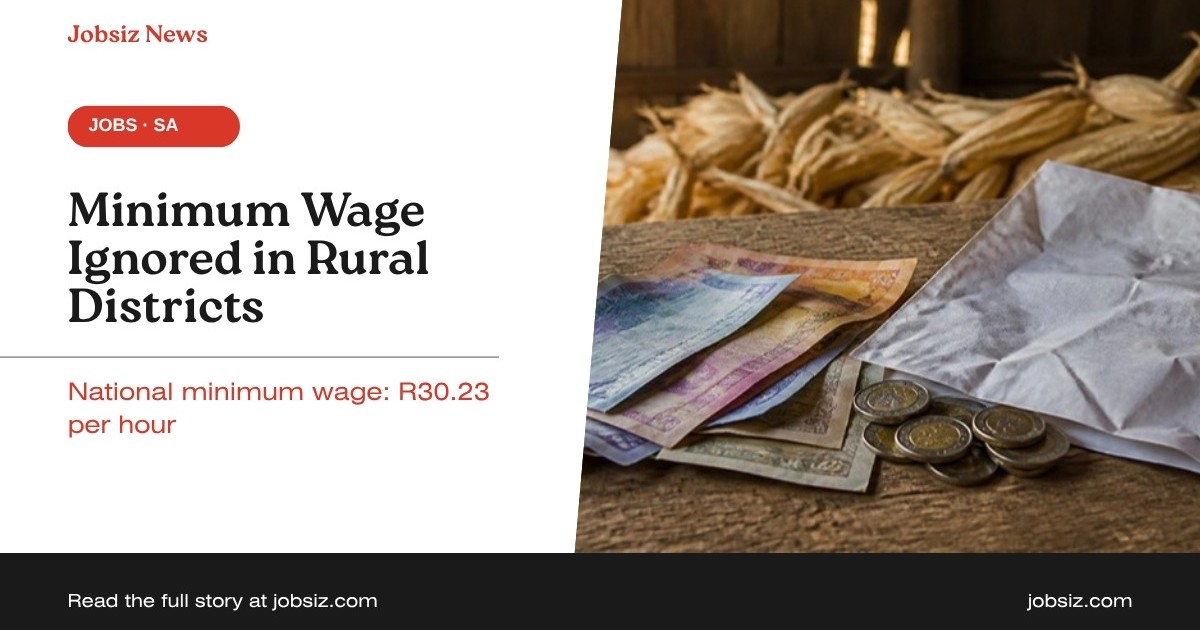
Quick answer: A National Minimum Wage Commission technical report finds the worst minimum wage compliance in rural districts such as uThukela, Harry Gwala and uMzinyathi in KwaZulu-Natal, Joe Gqabi in the Eastern Cape and Thabo Mofutsanyana in the Free State. In some districts, close to or above 70% of workers earned below the minimum, based on 2024 to 2025 survey data.
Key Takeaways
KwaZulu-Natal has three of the five districts with the highest apparent non-compliance: uMzinyathi, uThukela and Harry Gwala.
Joe Gqabi (Eastern Cape) and Thabo Mofutsanyana (Free State) are also flagged.
In some districts the share of workers paid below the minimum approaches or exceeds 70%; in the best-performing districts it is roughly 20% to 30%.
The national minimum wage has been R30.23 per hour since 1 March 2026.
Unions want it raised to R33 per hour from 1 March 2027.
Workers in South Africa's rural districts are far more likely to be paid below the legal minimum wage than those in big cities, according to the latest technical report by the National Minimum Wage Commission. The commission, which reviews and sets wage adjustments, has named several districts in KwaZulu-Natal, the Eastern Cape and the Free State as having the highest rates of apparent non-compliance in the country.
The findings, reported by Business Day and East Coast Radio this week, come as organised labour pushes for a higher minimum from March 2027 and as many households struggle with the cost of basic food.
Which districts have the worst minimum wage compliance?
According to East Coast Radio, KwaZulu-Natal accounts for three of the five worst-performing districts in the country: uMzinyathi, uThukela and Harry Gwala. The remaining two are in the Eastern Cape and the Free State. Business Day names those as Joe Gqabi in the Eastern Cape and Thabo Mofutsanyana in the Free State.
The commission's analysis looked at the impact of the 2025 minimum wage increase, using Statistics South Africa's Quarterly Labour Force Survey data for October 2024 to June 2025. In some districts, it found that the share of workers earning less than the minimum approaches or goes beyond 70%.
Why is non-compliance higher in rural areas?
The commission describes the worst-affected areas as mainly rural districts with low average wages, a narrow economic base and a heavy reliance on agriculture and low-skilled service jobs.
It also adds an important caveat. In these areas, payment in kind may make up a bigger part of what workers receive, and the survey data the commission used does not record it. The headline figures should therefore be read as apparent non-compliance.
Where is compliance best?
The picture is very different in South Africa's larger and more developed economies. The commission lists the City of Tshwane, Overberg, Mangaung, the City of Cape Town and Nelson Mandela Bay as having the lowest non-compliance rates. In the best-performing districts, an estimated 20% to 30% of workers earn below the national minimum.
Business Day points out that Tshwane and Nelson Mandela Bay are home to major vehicle manufacturers, where unions such as Numsa regularly demand above-inflation pay rises. In late 2025, Numsa signed a three-year deal with seven carmakers that gave workers 7% in July 2025 and 5.5% in each of the following years, along with a R12,500 once-off gratuity and a higher transport allowance.
What is the national minimum wage in 2026?
Amendments published in the Government Gazette on 3 February 2026 set the national minimum wage at R30.23 per hour from 1 March 2026. The key rates are:
Most workers, including farm and domestic workers: R30.23 per hour.
Expanded Public Works Programme workers: R16.62 per hour.
Learners on registered learnerships: weekly allowances of between R455.00 and R2,654.04, depending on NQF level and credits.
Some sectors have higher minimums under their own sectoral determinations. For example, contract cleaners in Area A must earn at least R33.27 an hour, while wholesale and retail rates for Area A range from R30.23 to R35.53 an hour for general assistants and from R34.62 to R43.29 for cashiers.
What happens next: the push for R33 an hour
Organised labour wants the national minimum raised to R33 per hour from 1 March 2027. The Federation of Unions of South Africa (Fedusa) says that would be an increase of about 9.2%, or R2.77 more per hour. For someone working a 40-hour week, monthly pay before deductions would rise to about R5,720.
Fedusa links its demand to food prices. It cites the Pietermaritzburg Economic Justice & Dignity Group, which put the average household food basket at R5,479.80 in August 2026 and its basic nutritional food basket at R6,597.25. The federation argues that a minimum wage worker has little left once these basics are paid for.
"A minimum wage must not become a maximum wage," Fedusa said.
The federation calls R33 an hour a transitional step towards a living wage rather than an end point.
What this means for you
If you work in agriculture, domestic work, retail or another low-wage job, especially in a rural district, check your payslip against the legal rate. Multiply your hours by R30.23 to see the minimum you should be earning before deductions, unless your sector has a higher rate.
Workers: keep records of your hours and payments. If you are paid below the minimum, you can raise it with your employer, your union or the Department of Employment and Labour.
Employers: the national minimum applies to farm and domestic workers in full. Make sure payslips show hours and rates clearly, and review pay regularly, as unions are pushing for an increase from March 2027.
Job seekers: when you get an offer, work out the hourly rate. Any offer below R30.23 an hour for a standard job is below the legal floor.
The report shows that, in parts of rural South Africa, many workers' pay still falls short of the legal floor.
Frequently Asked Questions
What is the national minimum wage in South Africa in 2026?
It is R30.23 per hour from 1 March 2026 for most workers, including farm and domestic workers. EPWP workers receive R16.62 per hour.
Which districts have the highest minimum wage non-compliance?
The National Minimum Wage Commission names uMzinyathi, uThukela and Harry Gwala in KwaZulu-Natal, Joe Gqabi in the Eastern Cape and Thabo Mofutsanyana in the Free State among the worst.
How many workers earn below the minimum wage in these areas?
In some districts, the share of workers earning below the minimum approaches or exceeds 70%, according to the commission's analysis of 2024 to 2025 labour survey data.
Which areas have the best compliance?
Tshwane, Overberg, Mangaung, Cape Town and Nelson Mandela Bay have the lowest non-compliance rates. In the best-performing districts, about 20% to 30% of workers are paid below the minimum.
Will the minimum wage increase in 2027?
No decision has been made yet. Unions, including Fedusa, are asking for R33 per hour from 1 March 2027, an increase of about 9.2%.
Sources
East Coast Radio – Three KZN districts shamed for minimum wage non-compliance
Business Day – This is where minimum wage rules are most ignored
Envoy Global – South Africa National Minimum Wage for March 2026
This article was compiled by Jobsiz from the sources listed above, with AI-assisted writing and automated fact-checking. Published 2 October 2026. We update stories when new verified information becomes available.