Michigan Minimum Wage 2027: $15 an Hour Starts January 1
Quick answer
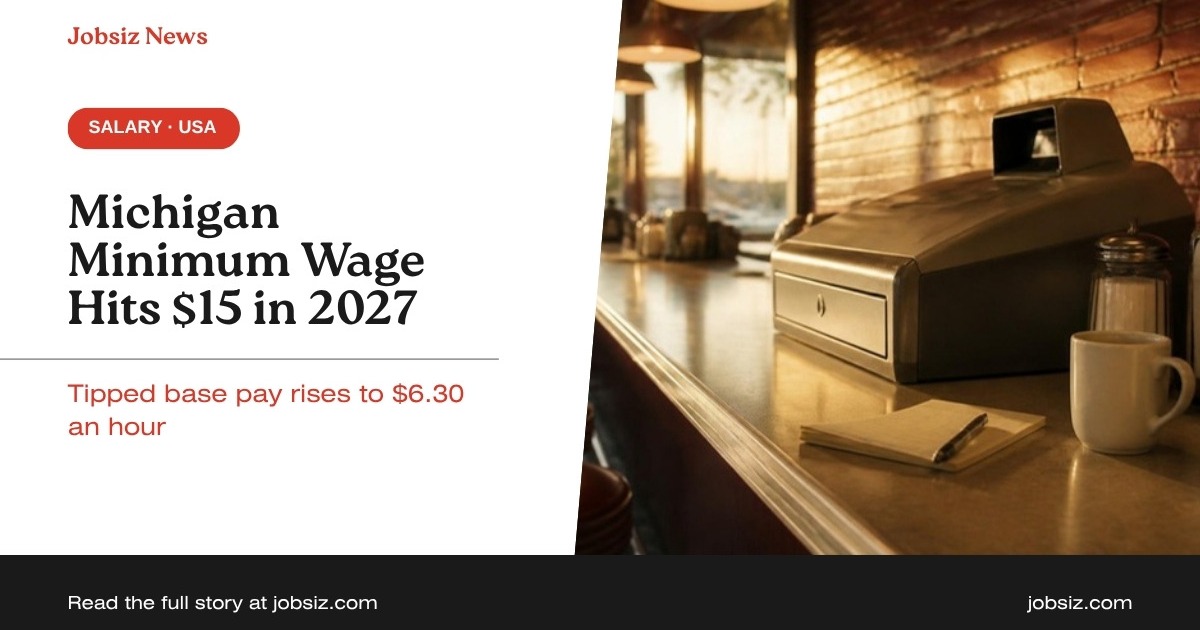
The Michigan minimum wage 2027 is $15.00 an hour, effective January 1, 2027, up from $13.73. Tipped workers can be paid $6.30 an hour (42% of the full rate) only if tips make up the rest, workers aged 16 and 17 must earn at least $12.75, and the $4.25 training wage for new hires under 20 stays.
Key takeaways
Michigan's general minimum wage rises from $13.73 to $15.00 per hour on January 1, 2027, a $1.27 increase written into state law.
The tipped minimum hourly wage moves from 40% to 42% of the full rate, which works out to $6.30 an hour in 2027.
Workers aged 16 and 17 must receive at least 85% of the general rate, or $12.75 an hour, from January 1, 2027.
Starting in October 2027, the State Treasurer will adjust the rate each year for inflation, published by November 1, unless state unemployment was 8.5% or higher the year before.
A full-time worker earning the new minimum for 40 hours a week over 52 weeks would gross $31,200 a year before taxes.
The Michigan minimum wage 2027 increase is already fixed in state law, and it completes the step-by-step schedule lawmakers set in 2025. On January 1, 2027, the general hourly rate climbs to $15.00, the tipped rate rises to 42% of that figure, and the rate for teenage workers goes up with it. Here is exactly what changes, who it covers, and how workers can check that they are being paid correctly.
Michigan minimum wage 2027: what is the new rate?
From January 1, 2027, the minimum wage in Michigan is $15.00 per hour. The Michigan Department of Labor and Economic Opportunity (LEO) lists the current rate as $13.73 per hour, in effect since January 1, 2026, and confirms the $15.00 rate for 2027.
The figure comes straight from Section 4 of the Improved Workforce Opportunity Wage Act, which sets three dated steps:
February 21, 2025: $12.48 per hour
January 1, 2026: $13.73 per hour
January 1, 2027: $15.00 per hour
The 2027 step is worth $1.27 an hour, an increase of about 9%. Because the amount is written into the statute, no further announcement is needed for it to take effect.
How much will tipped workers earn in Michigan in 2027?
Tipped employees can be paid a base wage of $6.30 an hour in 2027, but only when their tips cover the gap to $15.00. The law sets the tipped rate as a percentage of the general minimum wage, and that percentage rises every January:
2026: 40% of the minimum wage ($5.49 an hour)
2027: 42% ($6.30 an hour)
2028: 44%
2029: 46%
2030: 48%
2031: 50%
In 2027, a tipped server or bartender therefore needs at least $8.70 an hour in reported tips for the lower base wage to be legal. If tips fall short in a pay period, the employer must make up the difference so the worker reaches the full $15.00.
Conditions an employer must meet to use the tipped rate
Michigan does not let employers apply the tipped rate automatically. Under Section 4d of the act, all of these must be true:
The employee actually receives gratuities in the course of the job.
The tips equal or exceed the difference between the tipped rate and the full minimum wage.
The tips are proven gratuities, shown by the employee's tip declarations for federal payroll tax purposes.
The worker keeps all of their tips, apart from voluntary sharing with coworkers in the chain of service who are not mainly managers or supervisors.
The employer explained these rules in writing at or before hiring, and the employee gave written consent.
The law also states that tips and service charges belong to the employee and do not count toward the wages the employer owes.
What is the minimum wage for minors in Michigan in 2027?
Workers aged 16 and 17 must be paid at least $12.75 an hour from January 1, 2027. Michigan law sets the youth rate at 85% of the general minimum wage, so it rises automatically when the main rate does. In 2026, the same rule produced $11.67 an hour.
Does Michigan still allow a training wage?
Yes. An employer may pay a new employee under 20 years old a training wage of $4.25 an hour for the first 90 days of employment. The law forbids firing a worker, or cutting their hours, wages or benefits, in order to hire someone at the training wage. A violation carries a civil fine of up to $1,000.
Who is covered by Michigan's minimum wage law?
The act covers employees aged 16 or older who work for an employer with 2 or more employees at any one time during the calendar year. That includes private businesses, the State of Michigan, and its cities, counties and agencies.
The same law requires overtime at 1.5 times the regular rate for hours over 40 in a workweek. At the 2027 minimum, that means at least $22.50 for each overtime hour. Some groups, including employees in bona fide executive, administrative or professional roles, certain seasonal amusement businesses and agricultural workers, are exempt from the state overtime rule.
What does $15 an hour mean for a paycheck?
For a full-time worker, the new rate adds up to about $50 more per week before taxes. Here are simple gross-pay examples at the 2027 rate:
20 hours a week: $300 per week
30 hours a week: $450 per week
40 hours a week: $600 per week, compared with $549.20 at the 2026 rate
40 hours a week for 52 weeks: $31,200 per year
These figures are before federal, state and local taxes and any deductions, and they assume no overtime.
Will the Michigan minimum wage rise again after 2027?
Yes, with inflation. Beginning in October 2027, the State Treasurer must calculate an adjusted rate using the 12-month change in the Consumer Price Index for the Midwest region (CPI-U), published by the Bureau of Labor Statistics. The new rate must be published by November 1 and takes effect the following January 1, so the first inflation-linked rate would apply in 2028.
There is one safeguard. The inflation increase does not take effect if Michigan's unemployment rate was 8.5% or higher for the year before the scheduled increase.
Why is Michigan's minimum wage going up?
The increases trace back to a 2018 ballot initiative. Lawmakers adopted that initiative and later amended it to slow the raises. In Mothering Justice v. Attorney General, decided on July 31, 2024, the Michigan Supreme Court ruled the amendment unconstitutional and revived the original law from February 21, 2025. Legislators then passed Senate Bill 8, signed as Public Act 1 of 2025, which set the current schedule ending at $15.00 in 2027 and kept a lower tipped rate that phases up to 50% by 2031.
What workers and employers should do before January 1, 2027
The change is automatic, but a few checks now can prevent underpayment in January.
For workers:
Check your first January 2027 pay stub. Your base rate should be at least $15.00, or $12.75 if you are 16 or 17.
If you are paid the tipped rate, confirm you signed the written notice and that your base plus reported tips reach $15.00 an hour.
Keep your own record of hours and tips. It is the strongest evidence if a pay dispute arises.
If you believe you were underpaid, contact LEO's Wage and Hour Division, which administers Michigan's laws protecting workers' wages and lists the required workplace poster.
For employers:
Update payroll so the new rates apply to hours worked from January 1, 2027.
Review the written notice and consent for each tipped employee.
Replace the minimum wage poster with the current version from LEO.
Recheck any salaried roles that sit close to the new hourly floor.
Common mistakes to avoid
Assuming the tipped rate applies to everyone in a restaurant. It applies only to employees who receive tips and meet every legal condition.
Counting service charges as wages. The law treats them as the employee's money, in addition to wages.
Keeping a teen on the training wage after 90 days. After the 90-day period, the youth or adult rate applies.
Running January payroll on the 2026 rate. Hours worked from January 1, 2027, must be paid at the new rates, even if the pay period started in December.
Last updated: October 8, 2026.
Frequently asked questions
What will the minimum wage be in Michigan in 2027?
Michigan's minimum wage will be $15.00 per hour starting January 1, 2027. It replaces the 2026 rate of $13.73 per hour and is set directly in state law.
What is the tipped minimum wage in Michigan for 2027?
The tipped minimum wage is $6.30 per hour in 2027, which is 42% of the $15.00 general rate. The employer can use it only if tips bring the worker to at least $15.00 an hour and the other legal conditions are met.
How much do 16 and 17 year olds make in Michigan in 2027?
Workers aged 16 and 17 must earn at least $12.75 per hour from January 1, 2027. That is 85% of the general minimum wage.
Is the $4.25 training wage still allowed in Michigan?
Yes. Employers may pay new employees under age 20 a training wage of $4.25 an hour for their first 90 days. They may not displace existing workers to hire at that rate.
Will Michigan's minimum wage go up in 2028?
It is expected to rise with inflation. From October 2027, the State Treasurer must calculate an inflation adjustment and publish it by November 1, unless Michigan's unemployment rate was 8.5% or higher the year before.
How much is $15 an hour per year in Michigan?
At 40 hours a week for 52 weeks, $15.00 an hour equals $31,200 a year before taxes. Part-time workers earn proportionally less.
Who handles minimum wage questions in Michigan?
The Wage and Hour Division of the Michigan Department of Labor and Economic Opportunity administers the state's wage laws. Its website lists the current rates, minimum wage FAQs and the required employer poster.
Sources
Michigan Department of Labor and Economic Opportunity: Minimum Wage & Overtime
Michigan Department of Labor and Economic Opportunity: Wage and Hour Division
Michigan Legislature: MCL 408.934b, Training wage and minors
Small Business Association of Michigan: Michigan's Minimum Wage Will Increase January 1
Michigan Public: Minimum wages increase in Michigan on New Year's Day
This article was compiled by the Jobsiz editorial team from the official and news sources listed above, using AI-assisted writing and automated fact-checking. It is general information, not legal advice.