California Farmworker Minimum Wage 2027: New $19.75 Floor
Quick answer
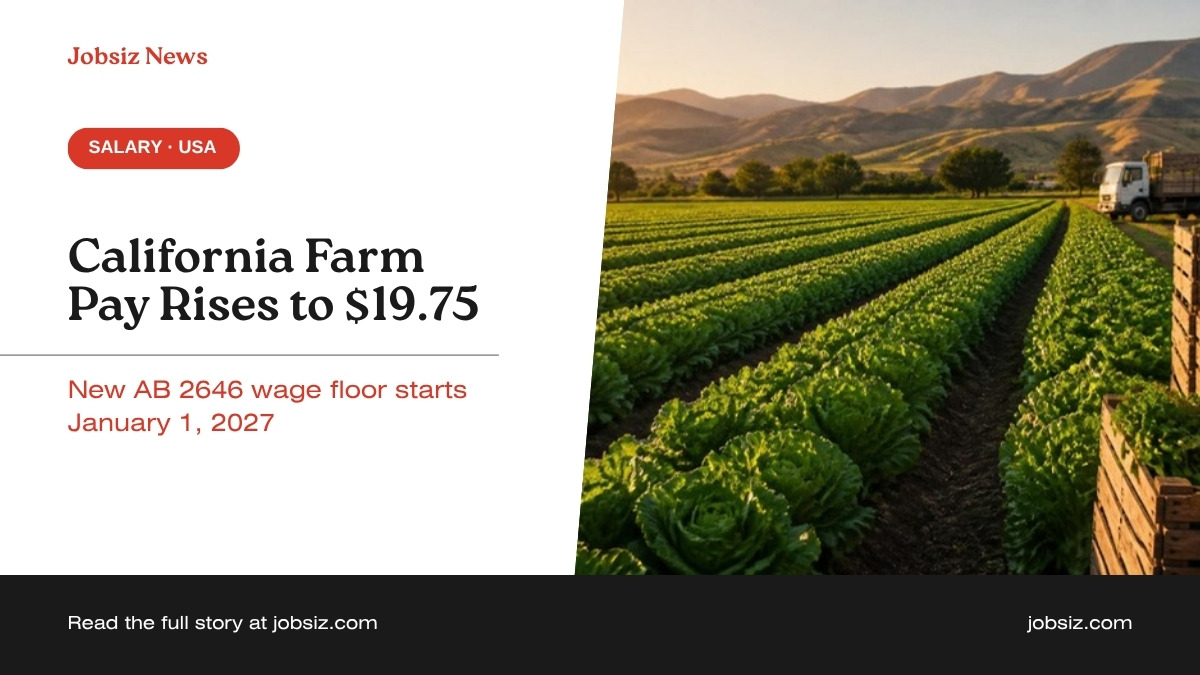
The California farmworker minimum wage 2027 is $19.75 an hour for workers covered by AB 2646, starting January 1, 2027. It applies to out-of-state seasonal farmworkers approved through the state process, typically H-2A visa holders, and to California farmworkers doing the same work for the same employer in the same county. Other farmworkers get the $17.40 statewide minimum.
Key takeaways
Governor Gavin Newsom signed Assembly Bill 2646 on September 30, 2026, creating a $19.75 hourly wage floor for certain agricultural workers from January 1, 2027.
The new rate covers temporary or seasonal farmworkers from outside California, in practice H-2A workers, plus California residents doing the same or substantially similar work for the same employer in the same county.
Farmworkers not covered by AB 2646 still receive California's statewide minimum wage, which rises from $16.90 to $17.40 an hour on January 1, 2027.
After 2027, the $19.75 rate is set to rise each year with a cost-of-living adjustment.
Major grower groups oppose the law, and the head of a national agricultural employers group says employers are weighing whether the governor's signature is the final word.
The California farmworker minimum wage 2027 will be $19.75 an hour for a defined group of agricultural workers. Governor Gavin Newsom signed Assembly Bill 2646 (AB 2646) on September 30, 2026, and the new floor takes effect on January 1, 2027. It sits well above the regular statewide minimum and is aimed mainly at seasonal crews hired from outside the state and the local workers who labor beside them.
For most people working on California farms, the key question is simple: does the higher rate apply to my job? This guide explains who is covered, how much more it pays, what employers have said, and what to do if your paycheck does not match the law.
California farmworker minimum wage 2027: what is the rate?
It depends on whether AB 2646 covers you. Covered agricultural employees must be paid at least $19.75 per hour from January 1, 2027. Every other farmworker falls under the statewide minimum wage, which the California Labor Commissioner's Office says rises to $17.40 per hour on the same date.
2026 statewide minimum wage: $16.90 per hour (all industries without a higher rate).
2027 statewide minimum wage: $17.40 per hour, certified by the California Department of Finance on July 31, 2026.
2027 AB 2646 agricultural floor: $19.75 per hour for covered workers.
Gap for covered workers in 2027: $2.35 more per hour than the statewide minimum, or roughly $94 extra for a 40-hour week.
Some cities and counties set local minimum wages above the state rate. When a local rate is higher, the employer must pay the higher amount, so always check the rules where you actually work.
Who qualifies for the $19.75 farmworker wage?
Two groups qualify: approved out-of-state seasonal workers and the California workers who match their jobs. The law calls them "approved agricultural employees" and "corresponding employees."
Approved agricultural employees
These are farmworkers who live outside California and hold permission to work in the state on a temporary or seasonal basis, usually for a position lasting no more than one year, through an application or job order approved by the state. The California Farm Bureau describes this group as workers on H-2A temporary agricultural visas, and employment law firm Fisher Phillips said in its analysis of the bill that H-2A hires would realistically be the only workers who fit this definition.
Corresponding employees
This group covers California residents engaged in agriculture who do the same or substantially similar work, during the same period, for the same employer, in the same county as an approved agricultural employee. Fisher Phillips notes that the state definition is broader than the federal H-2A version: in its reading, a farmworker employed by the same grower in the same county may be owed the higher rate even when the tasks are not listed in the employer's H-2A job order.
In plain terms, if your employer brings in H-2A crews and you work for that employer in the same county doing comparable farm work, you are likely in scope. If your employer hires no approved out-of-state seasonal workers at all, the $17.40 statewide minimum, or a higher local rate, is likely the floor that applies to you in 2027.
Who is excluded?
According to Fisher Phillips, people already exempt from California's minimum wage rules, such as the parent, spouse or child of the employer, appear to remain exempt under the new agricultural rate as well.
When does AB 2646 take effect, and will the rate rise again?
The $19.75 floor starts on January 1, 2027. After that, the rate is designed to increase every year through a cost-of-living adjustment. The California Farm Bureau reports that the adjustment is tied to the Social Security cost-of-living adjustment, so the exact figure for 2028 will depend on that federal calculation.
The bill moved through the Legislature over most of 2026:
February 20, 2026: Assemblymember Maggy Krell, a Sacramento Democrat, introduced AB 2646.
May 2026: The Assembly approved the bill 51 to 14.
August 25, 2026: The state Senate passed the bill on a party-line vote.
September 30, 2026: Governor Newsom signed it into law.
January 1, 2027: The $19.75 minimum takes effect.
Why did California create a separate farmworker minimum wage?
Supporters say the law stops employers from paying temporary farmworkers differently from Californians doing the same work. Krell told the Assembly the measure "restores farm worker pay at $19.75 an hour", calling it a restoration of the wage floor.
Fisher Phillips connects the bill to a federal change: in its view, AB 2646 is likely California's response to a U.S. Department of Labor interim final rule that reshaped how H-2A minimum wages are set and lowered H-2A wage rates in California. California already uses industry-specific minimums for fast food workers and certain health care workers, and this law adds agriculture to that list.
What are employers and grower groups saying?
Farm organizations strongly oppose the law and warn about costs. Western Growers President and CEO Dave Puglia said in a statement that most farmers cannot absorb or pass on the increase. California Citrus Mutual said it was disappointed by the governor's decision, and the California Fresh Fruit Association warned that making food harder to produce in California risks shifting more of the food supply to foreign production.
The Grower-Shipper Association of Central California argued that the measure is not a raise for farm work in general but a second wage floor that applies only where H-2A workers are employed. During the Assembly debate, Assemblymember Alexandra Macedo, who represents part of the Central Valley, questioned whether the approach could cost some workers their jobs.
John Hollay, president and CEO of the National Council of Agricultural Employers, told The Packer that employers are looking at options to see whether the governor's signature is the final word, and that he is waiting to see what implementation steps the California Labor Commissioner's Office lays out. Workers can watch the Labor Commissioner's website for any official guidance.
How will the new rate affect farmworker hours and jobs?
No one can say yet. Grower groups have warned that higher labor costs could lead to fewer hours and shorter seasons, while supporters say the law protects farmworkers and stops employers from paying temporary workers differently from Californians doing the same work. The practical effect will depend on how many employers keep using the H-2A program in California and how they schedule work after January 1, 2027.
Use of H-2A labor is uneven across the state. KMPH, citing federal immigration employer data, reports that the program is more common in regions such as the Salinas area than in the Central Valley. That means the number of workers who see the higher rate is likely to vary by region.
What this means for you
Whether you pick, pack or drive a tractor, a few steps will help you make sure you receive the correct pay once the California farmworker minimum wage 2027 rules begin.
Ask whether your employer uses H-2A workers. If it does, and you do similar work in the same county, the $19.75 floor likely applies to you.
Check your first pay stub of 2027. California employers must list your hourly wage rates on each pay stub, so compare them with $19.75 or $17.40.
Remember piece rates. State law says workers paid by the piece must still earn at least the minimum wage for the hours they work.
Keep your own records. Write down dates, hours, crews and fields, and keep copies of pay stubs.
Raise problems early. If your employer does not correct an underpayment, you can file a wage claim with the Labor Commissioner's Office or call its helpline at 833-526-4636 in English or Spanish.
The Labor Commissioner's Office says California labor laws protect workers in most industries regardless of immigration status, and it does not ask about immigration status when people file wage claims or retaliation complaints.
Last updated: October 8, 2026.
Frequently asked questions
What is the minimum wage for farmworkers in California in 2027?
It is $19.75 an hour for farmworkers covered by AB 2646 and $17.40 an hour for all other farmworkers. Both rates start on January 1, 2027. A higher local minimum wage applies if your city or county sets one.
Does the $19.75 wage apply to all California farmworkers?
No. It covers out-of-state temporary or seasonal farmworkers approved through the state process, in practice H-2A workers, and California residents doing the same or substantially similar work for the same employer in the same county. Other farmworkers generally receive the $17.40 statewide minimum or a higher local rate.
What is AB 2646 in California?
AB 2646 is a 2026 California law by Assemblymember Maggy Krell that sets a separate $19.75 hourly minimum wage for certain agricultural employees. Governor Gavin Newsom signed it on September 30, 2026, and it takes effect on January 1, 2027.
When does the California farmworker minimum wage increase start?
The $19.75 rate starts on January 1, 2027. After that, the rate is set to rise every year with a cost-of-living adjustment, which the California Farm Bureau says is tied to the Social Security adjustment.
Do H-2A workers in California get paid more than the state minimum wage in 2027?
Yes. Under AB 2646, approved temporary agricultural employees, which in practice means H-2A workers, must earn at least $19.75 an hour. That is $2.35 more than the $17.40 statewide minimum for 2027.
What should I do if my farm employer pays less than the new minimum wage?
First raise it with your employer and keep pay stubs and your own record of hours. If it is not fixed, you can file a wage claim with the California Labor Commissioner's Office or call 833-526-4636. The office says it does not ask about immigration status.
Sources
The Packer – New ag wage increase triggers strong backlash from farm groups
California Farm Bureau – H-2A minimum wage bill passes Senate
Fisher Phillips – New California bill calls for major wage hike in agriculture industry
This article was compiled by Jobsiz from the official and published sources listed above, with AI-assisted writing and automated fact-checking. It is general information, not legal advice.