Zimbabwe formalisation drive: what it means for informal workers
Quick answer: Zimbabwe's government is pressing ahead with its National Formalisation Strategy, approved by Cabinet in April 2026. Deputy Labour Minister Mercy Dinha told employers in Nyanga that the move must go beyond registration to bring informal workers social protection, finance, skills and decent workplaces, with simpler rules for small businesses.
Key Takeaways
Deputy Minister Mercy Dinha says formalisation must improve working conditions, incomes and social protection, not only paperwork.
The National Formalisation Strategy, approved on 7 April 2026, promises a voluntary, progressive and supported transition.
Government plans to simplify business registration and cut unnecessary compliance burdens.
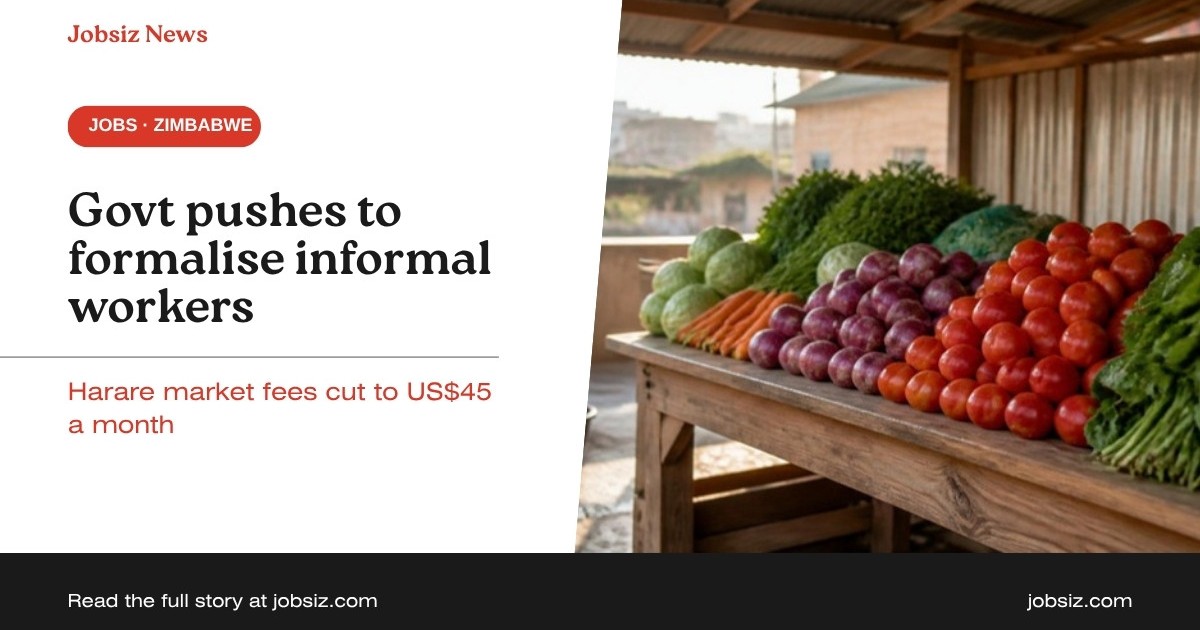
In Harare, a 60-day one-stop drive is moving vendors into designated sites, with market charges cut to US$45 a month.
A companion National Employment Policy (2026 to 2030) targets youth unemployment and skills mismatches.
The government has renewed its push to bring Zimbabwe's large informal economy into the formal system, and it says the goal is better protection and opportunity for workers rather than more red tape. Speaking at the 44th Annual Congress of the Employers Confederation of Zimbabwe (EMCOZ) in Nyanga, Deputy Minister of Labour and Social Welfare Advocate Mercy Dinha said formalisation should give people in informal work access to social protection, finance, markets and decent work.
For the many Zimbabweans who earn a living through trading, small businesses and other activities outside formal jobs, the message matters. It signals how the state plans to treat their enterprises, and what support may come with registration.
What did the government announce?
Dinha told the congress, held under the theme "Towards Inclusive Growth: Transition to Formality", that registration and compliance alone would not be enough. In her view, the process has to respond to the real conditions of workers and businesses by improving pay, skills, safety and access to technology, money and proper workspaces.
"Formalisation is not an end in itself." (Advocate Mercy Dinha, Deputy Minister of Labour and Social Welfare)
She said the government would keep reviewing laws and regulations so that registering a business becomes easier and unnecessary compliance costs are reduced. Employers were asked to uphold labour standards and workplace safety, and to help smaller and informal firms join formal supply chains. She also gave roles to universities, civil society, professional bodies and communities, mainly through research and evidence on the problems workers and firms face.
What is the National Formalisation Strategy?
The strategy was developed after a Cabinet directive and approved on 7 April 2026. According to the deputy minister, it provides for a transition that is voluntary, progressive and supported, with decent work at its core.
According to The Herald's report on the Cabinet decision, the plan seeks to connect informal workers and enterprises to social security, labour rights and financial services. Information Minister Dr Zhemu Soda said it would also create a clear growth path for small and medium enterprises by simplifying registration and access to finance. It is also meant to tackle long-standing problems in the sector, including weak social protection, unsafe conditions, low incomes and limited representation.
The strategy sets out eight priorities. Among them are employment-friendly economic policies, a review of regulations, enterprise development, better access to markets and finance, stronger representation for informal workers, and support for groups at the margins, particularly young people, women, persons with disabilities and veterans of the liberation struggle. Funding is expected to come from government, development partners, the private sector and social security institutions, with a monitoring and evaluation framework to track results.
The employment policy that came with it
Cabinet approved a second framework on the same occasion: the National Employment Policy for 2026 to 2030, which updates the 2010 framework. It has ten objectives, including stronger labour rights, inclusive growth, improved employment services and safer workplaces. It also aims to align education and training with what the economy needs, with special attention to youth unemployment and skills mismatches, and backs rural jobs through Village Business Units.
How is this playing out on the streets of Harare?
Formalisation is also playing out most visibly in the capital, through separate Cabinet-approved measures on vending in Harare. In September, Cabinet approved measures on informal vending in Harare's central business district built on four pillars: legislate, provide, formalise and enforce. A clampdown on illegal vending, called Chenesa Harare Final, was launched after a seven-day ultimatum.
Alongside enforcement, the government announced a 60-day one-stop formalisation drive with the City of Harare to help vendors register and move into designated trading spaces. The plans include:
Servicing 100 identified vending sites in the suburbs with water, toilets, lighting, shelter, waste collection and storage.
A new satellite market for traders on the edge of the CBD.
A Harare Vendors Council to help manage sites and settle disputes.
Links between formalised vendors and financial institutions for working capital.
Local Government Minister Daniel Garwe said fees at designated markets had been cut from a proposed US$100 a month to US$45, and traders would get six months to operate without paying. Other cities and rural district councils, including Bulawayo, Gweru and Kwekwe, were given a 30-day grace period for vendors to regularise before strict enforcement. Night vending remains banned because no city yet has the facilities to support it.
What happens next
Officials say implementation will rely on cooperation between government, employers and labour. Dinha urged EMCOZ delegates to turn congress resolutions into practical results, and said the state remains committed to tripartite social dialogue. The government has also said it will speed up the Municipal Police and Courts Bill to strengthen enforcement of council by-laws, and that measures on other urban problems will follow.
The real test will be whether registration actually opens doors to credit, markets and social security, as promised, and whether costs stay within reach for small traders.
What this means for you
If you run an informal business: registration is meant to become simpler. Watch for official guidance from your local authority and the Ministry of Labour on how to formalise and what support, such as finance links, comes with it.
If you are a vendor in Harare: trading is being moved to designated sites. Ask your council about available spaces, the reduced US$45 monthly charge and the six-month payment holiday.
If you are a vendor elsewhere: councils outside Harare were given a grace period before enforcement. Check with your town council about deadlines.
If you are job hunting: the new employment policy focuses on youth jobs and skills training. Look out for programmes linked to it, including rural initiatives such as Village Business Units.
Frequently Asked Questions
What is Zimbabwe's National Formalisation Strategy?
It is a government plan, approved by Cabinet on 7 April 2026, to move informal workers and businesses into the formal economy voluntarily and progressively, giving them access to social security, labour rights and financial services.
Will informal traders be forced to register?
Officials describe the national transition as voluntary and supported. However, illegal vending in Harare is being enforced against, and vendors are being moved to designated trading sites.
How much do vendors pay at designated markets?
Local Government Minister Daniel Garwe said charges were reduced from a proposed US$100 a month to US$45, with traders allowed six months before they start paying.
Is night vending allowed?
No. Night vending remains banned because local authorities do not yet have the infrastructure to support it.
What is the National Employment Policy 2026 to 2030?
It updates the 2010 policy framework and sets ten objectives, including stronger labour rights, inclusive growth, better employment services and safer workplaces, with particular emphasis on reducing youth unemployment and skills mismatches.
Sources
263Chat: Gvt Moves to Bring Informal Economy Into the Formal Sector
The Herald via Zimbabwe Situation: Cabinet approves policies to formalise informal sector
The Herald via Zimbabwe Situation: Government launches 60-day vendor formalisation drive
This article was compiled by Jobsiz from the sources listed above, with AI-assisted writing and automated fact-checking. Published 2 October 2026. We update stories when new verified information becomes available.