Tulbagh Cannery Closure: 424 Jobs at Risk as Merger Is Challenged
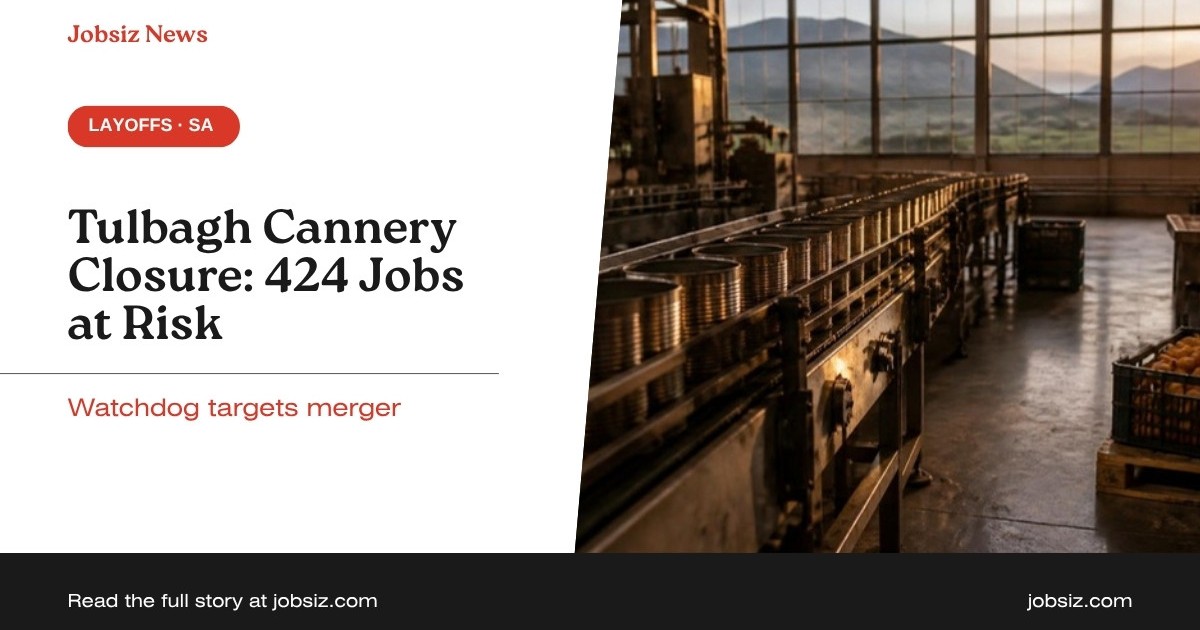
Quick answer: The Tulbagh cannery closure would affect 424 workers (246 permanent and 178 fixed-term) at Premier's Fruit Processing Western Cape plant. On 6 October 2026 the Competition Commission asked the Competition Tribunal to revoke approval of the Premier–RFG merger, saying the companies failed to disclose closure plans during the merger review.
Key takeaways
Premier says 424 workers at the Tulbagh fruit cannery in the Western Cape would be affected: 246 permanent and 178 fixed-term employees.
The Competition Commission filed an application on 6 October 2026 asking the Competition Tribunal to revoke its conditional approval of the Premier–RFG merger.
The Commission says its investigation found the merger parties did not disclose that they had discussed closing the plant before the deal was approved.
Premier's position is that shutting the factory is an operational and financial decision driven by problems in the global canned-fruit market, not a result of the merger.
Unions and growers want the closure paused for 12 to 24 months so that a sale, recapitalisation or other rescue can be explored.
Last updated: 7 October 2026
The Tulbagh cannery closure has turned into a regulatory fight. Premier Group plans to shut Fruit Processing Western Cape (FPWC), its fruit-canning factory in Tulbagh in the Western Cape, which would affect 424 workers. The Competition Commission now wants the Competition Tribunal to cancel its approval of Premier's merger with RFG Holdings, the company that owned the plant. For workers, growers and job seekers in Tulbagh and surrounding Western Cape towns, the outcome could shape what happens to the factory.
What is happening with the Tulbagh cannery?
Premier intends to close the Tulbagh cannery, and its board has already decided not to reopen it for the coming harvest season. Premier told the Competition Commission about the plan in July 2026, four months after the merger with RFG took effect on 30 March 2026.
FPWC is one of just two fruit-canning facilities in South Africa. The Commission says it is a route to market for roughly 200 fruit growers in the province, and an open letter from unions and producers put the figure at 200 to 220 suppliers. Premier says about 90% of what the factory produces is sold abroad.
How many jobs will the Tulbagh cannery closure affect?
According to Premier, the shutdown would affect 424 employees: 246 on permanent contracts and 178 on fixed-term contracts. The Competition Commission describes the impact as more than 400 permanent and fixed-term workers, plus thousands of seasonal workers in the wider farming value chain.
Unions say the damage will spread well beyond the factory gate. The communities they named as exposed include:
Tulbagh
Saron
Gouda
Wolseley
Ceres
Hermon
They also warn that transport operators, contractors, engineering firms, input suppliers and local shops all depend on the plant. The signatories also point out that deciduous fruit trees typically live for 20 to 30 years, so orchards that are removed represent a long-term loss.
Why does the Competition Commission want the merger revoked?
The Commission says Premier and RFG withheld material information about the possible closure while the merger was being reviewed. On 6 October 2026 it applied to the Competition Tribunal under section 16(3) of the Competition Act to revoke the conditional approval the Tribunal granted on 6 March 2026.
The Commission's case, as set out in its 7 October statement, rests on these points:
Before the merger was referred to the Tribunal, and again before it was approved, the merger parties said they did not plan to close, integrate or consolidate any production facilities.
The Commission had expressly asked them to confirm their post-merger plans for their plants.
Its investigation found the parties had known about, and discussed, the option of closing the cannery before approval was granted.
The Commission argues that closing FPWC would leave Langeberg with no local competitor, effectively creating a monopoly in fruit canning.
Competition Commissioner Doris Tshepe said the Commission "cannot properly assess the competition and public-interest consequences of a transaction when crucial facts are withheld". These are the Commission's allegations; the Tribunal has not yet ruled on them.
The investigation followed a complaint lodged by, among others, the Southern African Clothing and Textile Workers' Union (SACTWU), which argued that the closure would lead to retrenchments that breach the merger conditions.
What did the merger conditions say about jobs?
The Tribunal's approval came with employment protections. During a three-year moratorium, Premier may not cut jobs because of the merger itself. A clause added at SACTWU's request puts the burden on Premier to prove that any job cuts are not linked to the merger, rather than on the workers to prove that they are.
The same conditions still allow retrenchments for operational reasons that are unrelated to the merger. That is the core of Premier's defence: the company says the closure is an operational and financial decision. Earlier in the investigation, the Commission said that if a breach is confirmed, the competition authorities can fine a firm up to 10% of its South African turnover and exports from South Africa for the previous financial year, or revoke the merger approval.
Why is Premier closing the factory?
Premier says the Tulbagh cannery closure is driven by long-term structural problems in the global canned-fruit industry. The factors it has named are:
global oversupply of canned fruit;
higher United States tariffs;
uncertainty over the African Growth and Opportunity Act (AGOA);
exchange-rate pressure;
consolidation in the canned-fruit industry.
Because the plant relies so heavily on exports, Premier argues that worsening international markets hit it especially hard.
What are unions and growers asking for?
Unions and growers opposing the Tulbagh cannery closure want the Section 189 retrenchment process put on hold for 12 to 24 months while alternatives to closure are examined. An open letter to Premier chief executive Kobus Gertenbach carried the signatures of the Canning Fruit Producers' Association, Solidarity, the National Union for All Sectors, and the Congress of South African Trade Unions (COSATU) with its affiliates.
The signatories say the standard 60-day consultation is too short to explore a sale, recapitalisation, repurposing or a different business model. Consultations at the Commission for Conciliation, Mediation and Arbitration (CCMA) broke down in late August after Premier objected to two worker representatives taking part; the CCMA commissioner was due to rule on the objection before talks resumed on 8 September, and the consultation deadline was 26 September. The Agricultural, Food and Allied Democratic Workers' Union (Afadwu) warned that even if a buyer were found, it would come too late for the apricot season that starts in November. No outcome of the consultations has been reported.
What happens next?
The next step in the Tulbagh cannery closure dispute is for the Competition Tribunal to hear the Commission's revocation application. The Commission's statement does not give a hearing date. If the Tribunal sides with the Commission, the approval of the Premier–RFG merger could be cancelled, and the outcome will shape whether the closure proceeds.
What this means for you
If you work at the Tulbagh cannery, or for a grower, contractor or transport firm that supplies it, these practical steps can help while the case runs:
Keep copies of your contract, payslips and any letters about the consultation process.
Ask your shop steward or union which category you fall into: permanent, fixed-term or seasonal.
Follow official updates from the Competition Commission and the Competition Tribunal rather than rumours on social media.
If you are job hunting in the Western Cape agri-processing sector, start early, because seasonal work linked to the plant may not return this harvest.
A common mistake is assuming the merger conditions automatically stop all retrenchments. They block merger-related cuts, but they do not block job losses for operational reasons that are unrelated to the merger. Whether the Tulbagh cannery closure falls on one side of that line or the other is exactly what is now in dispute.
Frequently asked questions
Why is the Tulbagh cannery closing?
Premier says the Tulbagh cannery closure is an operational and financial decision. It points to global oversupply, higher US tariffs, uncertainty over AGOA, exchange-rate pressure and consolidation in the canned-fruit industry. About 90% of the factory's output is exported.
How many workers are affected by the Tulbagh factory closure?
Premier says 424 employees are affected: 246 permanent and 178 fixed-term workers. The Competition Commission adds that thousands of seasonal workers in the wider agricultural value chain would also feel the impact.
Who owns the Tulbagh cannery?
The plant, Fruit Processing Western Cape, belonged to RFG Holdings (Rhodes Food Group). Premier Group took it over through the merger approved by the Competition Tribunal on 6 March 2026 and implemented on 30 March 2026.
Can the Competition Tribunal reverse the Premier–RFG merger?
Yes, revocation is possible. The Commission applied on 6 October 2026 under section 16(3) of the Competition Act to revoke the conditional approval, alleging non-disclosure of closure plans. The Tribunal has not yet ruled.
Do the merger conditions protect Tulbagh workers?
Partly. The conditions bar merger-related retrenchments for three years and require Premier to prove any cuts are unrelated to the merger. However, they still allow retrenchments for operational reasons that have nothing to do with the merger.
What do unions want Premier to do?
The Canning Fruit Producers' Association, Solidarity, the National Union for All Sectors and COSATU with its affiliates want the closure process paused for 12 to 24 months. They say this would give time to find a buyer, recapitalise or repurpose the factory.
Sources
BusinessTech: Shutdown of 72-year-old factory in South Africa could blow up R6.5 billion merger
Bizcommunity / GroundUp: Premier Foods factory closure: Talks break down
Freight News: Tulbagh plant closure threatens fruit export chain
This article was compiled by Jobsiz from the sources listed above, with AI-assisted writing and automated fact-checking. Published 7 October 2026. We update stories when new verified information becomes available.